
GEO vs SEO: How to Get Your Business Found in AI Search in 2026
Search is changing
For years, businesses focused on one main goal: ranking higher on Google. Today, that is still important—but it is no longer the whole picture.
People are increasingly using AI-powered search experiences to ask longer, more conversational questions and get summarized answers instead of simply browsing a list of websites. Google reports that AI Mode queries are more than doubling every quarter, while AI Overviews now have more than 2.5 billion monthly active users.
This is where GEO—Generative Engine Optimization—comes into the picture.
What Is GEO?
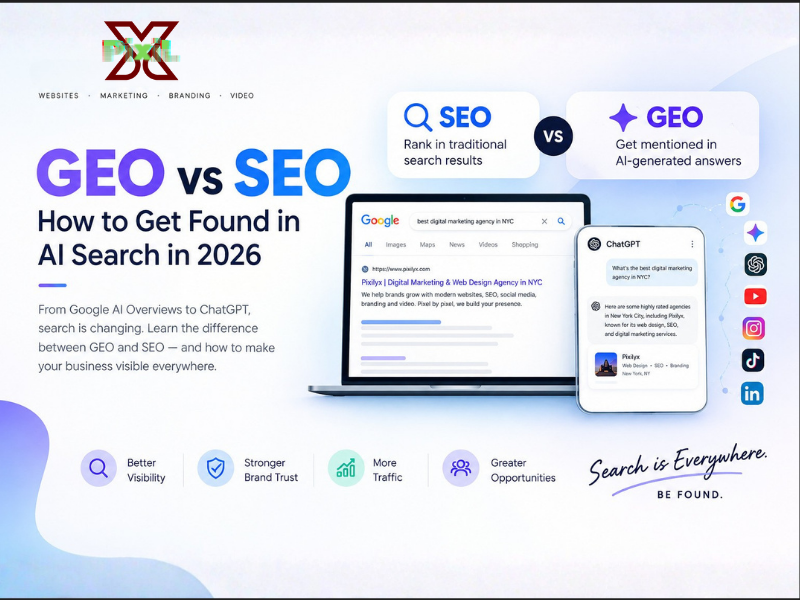
GEO is the process of creating and structuring content so that AI-powered search systems can better understand, trust, and potentially reference your business.
Traditional SEO focuses heavily on questions such as:
“How do I rank on Google?”
GEO adds another question:
“How do I get my business mentioned when someone asks an AI search engine for a recommendation or answer?”
The goal isn’t to replace SEO. Instead, GEO expands your search strategy for an environment where people discover information through Google AI Overviews, AI Mode, ChatGPT, and other AI-powered platforms.

SEO Isn't Dead—It's Expanding
There is a common misconception that AI search means traditional SEO is no longer necessary.
That’s not the case.
Your website still needs:
- Strong technical SEO
- Helpful content
- Relevant keywords
- Fast performance
- Mobile-friendly design
- Internal linking
- Clear business information
- Trustworthy external references
What is changing is how content is discovered and consumed.
Google’s AI Search features are designed to connect users with relevant websites and supporting sources, meaning quality web content remains an important part of the ecosystem.
Why Long-Tail and Conversational Searches Matter
AI search encourages people to ask complete questions rather than typing a few keywords.
Instead of:
“SEO NYC”
a potential customer might ask:
“What is the best SEO strategy for a small business in New York City?”
Or:
“How can a local business get more customers from Google without spending heavily on advertising?”
Your website should provide clear answers to these types of questions.
This means businesses should create content around topics, questions, problems, and customer intent—not just individual keywords.
Build Content That AI Can Understand
If you want your business to become more visible in AI-driven search, make your website easy for both people and search systems to understand.
Focus on:
1. Answering Real Customer Questions
Create articles, FAQs, service pages, and guides that directly answer questions your customers actually ask.
2. Demonstrating Expertise
Don’t simply say that you’re an expert.
Show it through:
- Detailed guides
- Case studies
- Original insights
- Examples
- Industry knowledge
- Helpful resources
3. Strengthening Your Brand
AI search doesn’t only need information—it needs reliable entities and sources.
Make sure your business has consistent information across your website, social platforms, business directories, and other relevant online sources.
4. Creating Original Content
Generic content is becoming increasingly difficult to differentiate.
Share your own experience, processes, examples, opinions, research, and customer insights.
5. Optimizing for Multiple Search Platforms
Search no longer happens exclusively on Google.
Customers may discover businesses through:
- Google Search
- Google Maps
- YouTube
- TikTok
- ChatGPT
- AI search platforms
This is why the idea of Search Everywhere Optimization is becoming increasingly important.
GEO + SEO + Social Media = Stronger Visibility
Your website should not operate in isolation.
Imagine a customer searches for your company and finds:
- Your professional website
- Google Business Profile
- Helpful blog articles
- YouTube videos
- Instagram content
- LinkedIn posts
- Customer reviews
Each touchpoint reinforces your brand.
Social media is also becoming an increasingly important discovery channel. Research from HubSpot indicates that social platforms are increasingly functioning as search, shopping, and customer-service environments, with social search becoming particularly important for younger consumers.
What Should Businesses Do in 2026?
The answer is simple:
Don’t abandon SEO. Expand it.
A modern search strategy should combine:
SEO → Rank in traditional search
GEO / AEO → Improve visibility in AI-generated answers
Local SEO → Reach nearby customers
Social Search → Get discovered on social platforms
Video SEO → Build visibility through YouTube and video content
Brand Building → Become a recognizable and trusted source
Together, these create a much stronger digital presence.
The Future of Search Is Everywhere
The future of search isn’t simply about getting position #1 on Google.
It’s about being visible wherever your customers are looking.
Google’s AI Search developments show that people are increasingly asking longer, more complex questions and exploring information through conversational experiences.
For businesses, that creates a major opportunity.
The brands that invest in useful content, strong websites, video, social media, local visibility, and AI-friendly information today can build an advantage as search continues to evolve.
Final Thoughts
SEO isn’t disappearing.
Search is expanding.
The businesses that succeed in 2026 and beyond will be the ones that stop thinking about visibility as simply “ranking on Google” and start thinking about being discovered everywhere.
At Pixilyx, we combine website development, SEO, digital marketing, content, social media, branding, and video to help businesses build a stronger digital presence.
Pixel by pixel, we build your presence.